
Green code and AI brainstorming
02 | 2024 Sanna Valkeejärvi & Tomas Günther, Solution Architect & Fullstack Developer
"Kipinä has a lot of experienced guys with a passion for problem solving. We're in the business of helping customers, and we genuinely want to understand what's most useful to the customer."
One of Kipinä's experts is Tomas Günther, who has 23 years of overall experience in the field and 2.5 years at Kipinä. He followed in his father's footsteps into the IT industry. At home, even as a child, there was a PC and later an Amiga 500, which were fun for playing games, drawing, making music, and experimenting with very basic programming. While getting games to work, Tomas learned a bit about computer hardware, software, and operating systems. In the late 90s, while in high school, he built his first company website.
"In high school, I started thinking more seriously about what I would do in the future. In addition to engineering, which I thought would offer good employment opportunities, I was interested in languages, psychology, music, biology and advertising. When the students came to present their school, I was impressed by their relaxed manner and their stories about their studies, and also shed some preconceptions about the field. After that, a friend and I went to see the University of Technology on the spot and I haven't looked back since," says Tomas, describing his career choice.
23 years of experience with many changes.
"There have been big changes on the methodological side of software production. Back in the early 2000s, when I was a student at university, we learned how to use XP and SCRUM, but for quite a long time we were working with the waterfall model and other rigid methods. Back then, the developer's job description was often more limited than it is today. For example, there might be completely different people writing specifications or documentation for a project. And after implementation, it was considered a good thing if the system didn't need to be touched for a long time."
"Today, there is a greater appreciation for the need to react quickly to an adaptive environment. DevOps culture even optimises how quickly an additional feature can be delivered to production when a need arises. In addition, things like automation testing, code review, and building automated release pipelines have grown in importance compared to the early days of my career."
"Another positive change has been the increased appreciation of developers. Companies like Kipinä were hardly known to me, except perhaps in the startup world."

Tomas is one of the first experts on Kipinä. Picture from Kipinä Symposium 2021
From debate bots to language models
"In the 2010s, customers started to move from their own data centres to the cloud. There has been and still is a lot to learn in the cloud world, but you learn best by doing! Fortunately, many projects have allowed me to see and do different solutions."
"In recent years, machine learning with its models that predict the world and artificial intelligence that mimics human capabilities have grown in importance. In particular, large-scale language models (LLM) have surfaced," Tomas continues.
Tomas sees more opportunities than threats with large language models, although in his own words he was initially rather sceptical about the usefulness of ChatGPT, for example.
"About 20 years ago, I had already been playing around with a language-learning and creatively integrating conversation software called MegaHAL and using it to build conversation bots for IRC chat channels. The text produced by large language models is based on probabilities, i.e. predicting the next word in the text. Because I knew how to frame questions in a certain way based on my MegaHAL experience, ChatGPT's answers easily veered more towards absurd humour.
However, the GPT model has been further trained and educated, and recently it has been of some help in dealing with various issues, including work-related matters. With ChatGPT, you can even have a one-to-one brainstorming session. And when you learn how to write questions correctly (prompt engineering), you get more useful answers. Recently I've been experimenting with building my own GPTs and using the contents of my own PDF documents as part of the model data!"
"In programming, AI will speed up the writing of simple, repetitive code. In addition, programming per se will be reduced, but this does not mean that people will not be needed. People will do more of a publisher's job, controlling the machine."
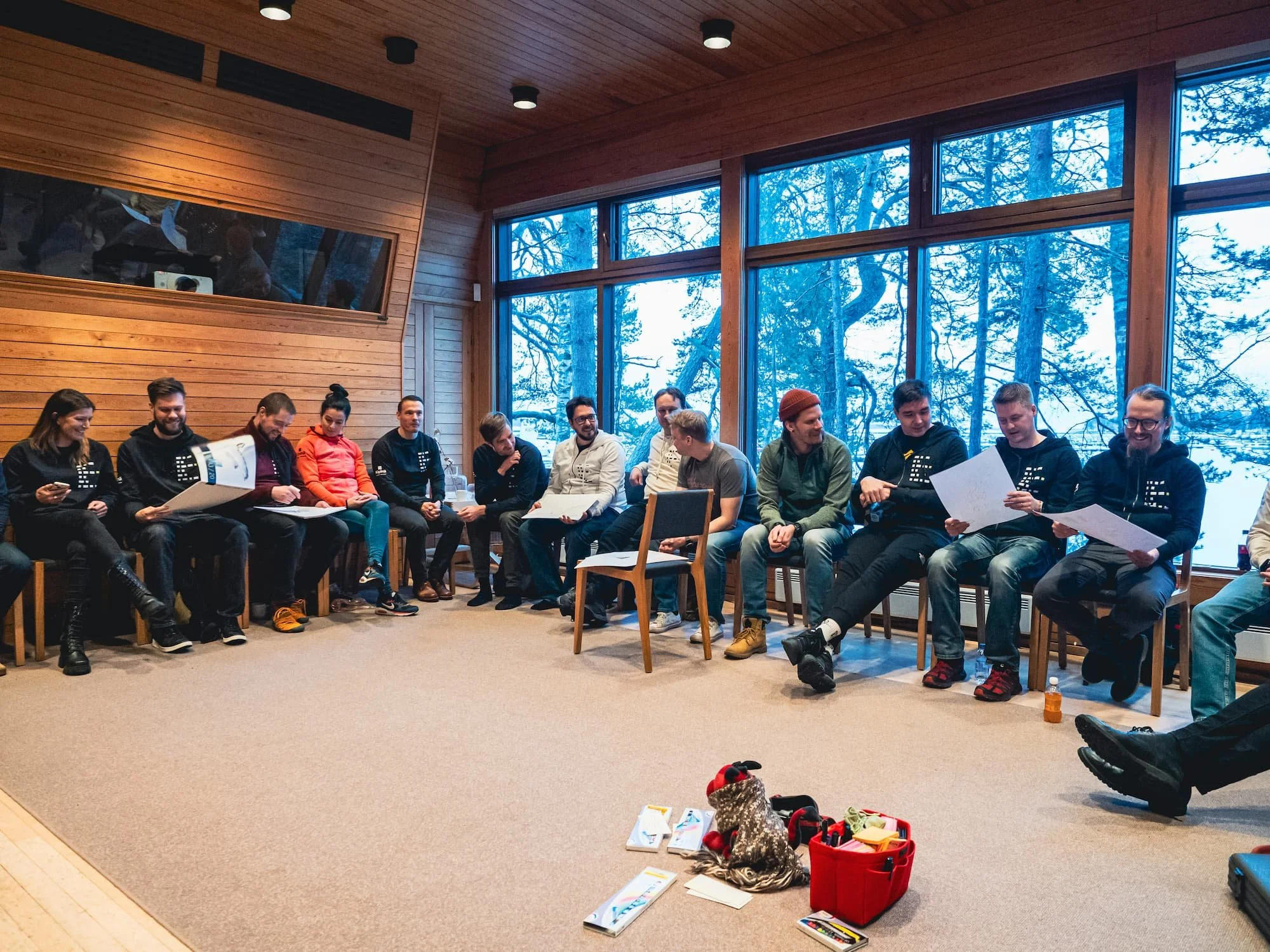
AI featured strongly in Kipinä's Future workshop
About the future
Change is happening all the time. How does Tomas see the future of the industry?
"I hope that ethical issues will be remembered when using AI and ML models to make the world more efficient. It is essential to understand how the data used to train the model affects the answers the model produces, and that the answer the model produces is not the truth but a probability of the matter. It is important, for example, that the data includes representation of all types of people so that the model answers are fair and non-discriminatory. Of course, there is also the issue of data security, and the safety and reliability of AI, for example in self-driving cars and medical diagnoses."
"The tools for using machine learning and artificial intelligence are already at a good level, but users need to understand how to use them properly. The developers of the models and the organisations that use them have a lot of responsibility and their performance needs to be monitored. This responsibility needs to be understood because it affects the whole world. When we talk about credit card or subsidy decisions, for example, they can be automated by AI, but we also have to consider the possibility of wrong decisions and prioritise fairness of decisions."
Green values and the green code are even more relevant for Tomas. The efficiency of code and solutions should be more valued as part of quality software and sustainable development. However, sustainable development (pun intended) does not necessarily mean slow development, as efficient solutions are often also simpler to implement.
"People will still be needed in the future. For example, language models and cloud services cannot work without people. They also need to be developed and maintained. We will continue to need a wide range of people. The importance of data will not diminish, but people will be needed to interpret it and make the choices that follow. Perhaps. There are probably jobs for people in deep learning, or at least in people-oriented jobs in the physical world."

Kipinä's Code Retreat was a coding race
Competence development in Kipinä
How do experienced experts make sure they keep up with change?
"There are many ways. The best way to learn is by doing things in practice in projects, but there are other ways to learn. At Kipinä, we talk quite a lot about technology and how it's evolving. We've also just spent a day together talking about the hallmarks of good code and the code lifecycle. In addition, last year Kipinä experts participated in sales training and strategy sessions have been held. And we have jointly agreed that we will each have 60 hours per year to spend on skills development in the way we choose during working hours.
"Kipinä has experienced people who are eager to solve problems. We are helping our clients and their customers with our expertise, working in collaboration with the client. We strive to truly understand the client’s needs and then provide what will be most beneficial for them. At Kipinä, we don’t just sell a technical solution, but also insight, expertise, and the support of our network, all of which lead to results."