
Communication and coding
11 | 2023 Sanna Valkeejärvi & Aki Smolander, Senior Software Developer
Aki Smolander has been in the IT industry since 2006, 17 years. After more than a year at Kipinä, he is a very experienced professional. "When you do a lot of different types of projects, for customers in different industries, it keeps you interested," says Aki as a reason for staying in the industry.
In his own words, Aki has done all kinds of things in the industry, a kind of generalist Jantunen. But I guess there's a bit of modesty involved, after 17 years of coding, web development, fiddling with data and embracing artificial intelligence and its exploitation. A hard-ass in the digital world, more like. Aki has done integrations, front-end and back-end coding, data projects, cloud and on-premises implementations. Mostly he has been in consulting houses, but his experience is enriched by a moment in a product house as well.
How has the industry changed in 17 years, in Aki's experience?
"When I started in the industry, all the projects were software and desktop applications running in data centres. Today, cloud platforms are involved in almost every project in one way or another.
It's typical for the industry to always be jumping on something new, whether it's cloud, outsourcing, data or the current AI boom. Cloud platforms really changed the industry. It's faster to build a project from scratch with an infra and release new software today compared to the old days. Cloud platforms also set the stage for the data boom, with very cheap and scalable storage becoming available to everyone. AI, on the other hand, has already transformed the industry by improving developer productivity through various assistive tools such as copilot and chatGPT. Of course, these products will not replace coders now, nor will they in the future."
According to Aki, the challenges that customers face and the challenges of customer work are fairly permanent.
"Communication with customers has to be at a really good level. It's up to us experts to make customers understand what we're doing and how we're helping the customer, when there's rarely anything concrete to touch and see when you go to create something new and improve digital services. Fluent communication is one of the cornerstones of the way Kipinä's experts operate in their senior tech leadership role."

"You need to have a really good level of communication with both clients and colleagues."
How to use AI properly?
"Communication with AI is important, a bit like with customers and in all human relationships. You have to be critical about what answers you get from AI, good communication helps you get better answers."
"For us in Kipinä, AI is one tool among others. A large part of us use it, if not daily, then weekly to help us code. But even though AI does some of the coding, still, all the tacit knowledge gained through experience, and of course the communication, plays a big role in our work. When working with AI, remember that the answers it provides should not be taken as the straight truth, sometimes it provides some pretty shit too. AI helps us as developers a lot, not to mention the opportunities it opens up for what we do for customers and their business as part of other developments."
"Data is a double-edged sword"
Data is constantly being collected and everyone, individuals and businesses alike, could benefit from using it wisely.
"As a private person, I would prefer that no data is collected about me," Aki says with a smile and continues:
"But all the time data is being collected and stored. There's a different kind of space for storing data today than there was in the past, and the cost of that space is not high. It's the analysis of the data that costs money and is worth investing in. The key is to learn to use data for other purposes than advertising, and to use it more sensibly. For example, the purchase history of online shops is available, but its use for customer service is still lacking." In Aki's work, data is a well-established tool.
Problem solver Smolander
Aki sees himself as a problem solver towards customers. He says that his own work is a nice variety of nuts to crack that don't repeat themselves.
"Actually, there is no problem I would like to solve more than any other. Any problem that you can help a customer by solving is meaningful work. But of course, my own skills are best in different kinds of integrations, data pipelines and cloud infrastructures. I think you get a hard worker who can do almost anything." A good superpower.
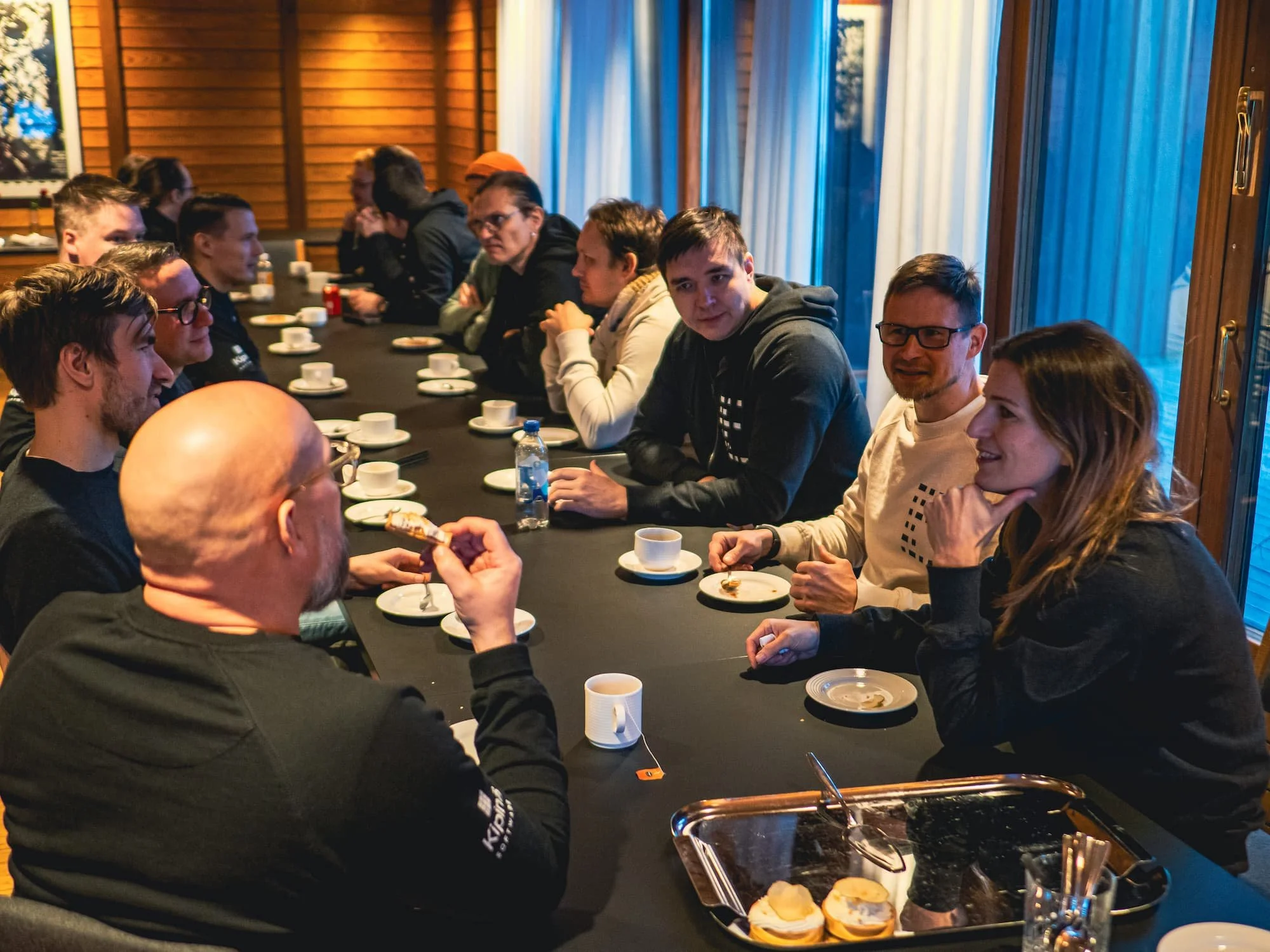
In Kipinä, decisions are made together and communication is open.
On excitement, participation and customer experience
Aki has now spent more than a year in Kipinä. And he's really enjoyed it.
"We have a close-knit community. I like the fact that Kipinä is a small enough company that everyone knows each other. I also like the fact that decisions are genuinely made together, even if it can sometimes take more time."
A community of experienced professionals and the whole ecosystem is in the best interest of customers, according to Aki.
"Kipinä partnership model and the whole ecosystem approach is a winning choice for the sector. We have motivated experts and little if any turnover because everyone is a part owner. Well-motivated and committed people shine better for the client and work wonders."