
04 | 2026 Kipinä Software
Creative professionals need to pause from time to time and make room for experimentation. The best way to understand new tools is to use them for exploring ideas that genuinely spark your interest.
Kipinä's Friday hackathon was four hours stripped of specs, backlogs, and predefined problems. Just an open floor and the curiosity to see what happens when years of engineering expertise meet modern AI tools.
Read about the ideas, solutions, and insights born during the hackathon!
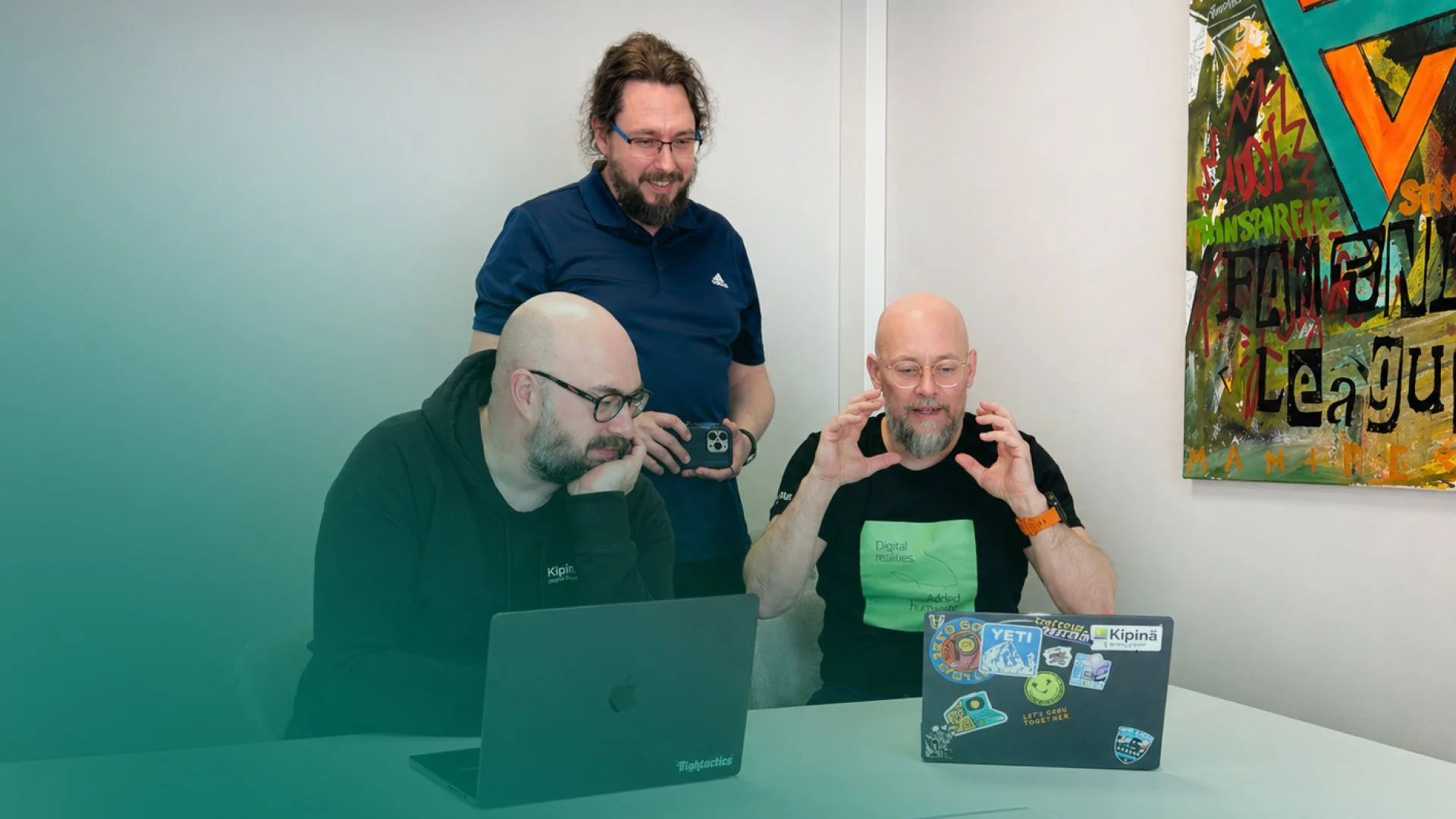
Insights from the AI Hackathon
Four hours is a short timeframe, but it is plenty for validation—testing whether an idea holds water, whether the technology is viable, and how an AI tool behaves when tackling specific types of problems.
Domain expertise remains the decisive factor.
The best results emerge where the practitioner possesses a deep understanding of the problem. Market analysis is only useful when you know what questions to ask. A security report is only valuable when you know how to interpret it. Artificial intelligence accelerates thinking and execution, but it cannot replace the experience-driven ability to scope, prioritize, and make meaningful decisions. Without this foundation, AI simply generates volume, not quality.
Upfront design pays dividends.
Establishing a clear architecture before implementation saves more time than any single tool. When a problem is well-structured, the AI performs better as well: prompts become more precise, iteration decreases, and the final output improves.
A recurring pattern in the hackathon was that those who invested a moment in planning ultimately moved faster and progressed further.
The discovery phase has been fundamentally transformed.
Validating a product idea—comprising market analysis, competitor mapping, prototyping, and iteration—has traditionally taken weeks. Today, it can happen in a matter of hours, provided the team already possesses domain expertise. This fundamentally shifts how rapidly we can help our clients test and validate ideas.
The value of an experimental culture is paramount.
As the threshold for trying new things lowers, the deciding factors become the courage to experiment and whether the organizational culture accommodates failure. For us, this courage is no accident; it is the result of years of intentional community-building. The four-hour hackathon yielded six distinct projects, lively professional discourse, and at least one operating model that we are actively moving forward with. Above all, it reinforced what we have believed from day one: the best insights and learnings happen when people are given the space to experiment together.
Here are examples of the ideas and solutions created in four hours:
From Frustration to a Product
Arto and Kari are passionate enthusiasts in a sport where current digital tools are frustrating and buggy. Knowing precisely what does not work, what users require, and what a genuinely useful solution would look like, they leveraged Claude over four hours to build a market analysis and validation: a comparable product does not actually exist in Europe.
The prototypes, competitor analysis, and product idea iteration were surprisingly functional given how rapidly they were produced. This was not mere 'vibe coding,' but rather a product development discovery phase that traditionally consumes weeks or months, compressed here into hours. The reason is simple: a profound understanding of the problem rooted in actual user experience.
AI-Powered Analytics for Sports Results Services
Olli, our resident sports fanatic and Kipinä's CEO, built an AI analytics tool for sports results services during the hackathon. The analysis streams to the user in real-time, while the admin backend handles access rights and tracks costs and executed analyses on a per-user basis.
From the CEO's perspective, the experiment struck at the heart of a pressing question for many enterprises: how do you ensure that AI expenses remain controlled and that usage aligns with value?
The solution utilized Vercel's AI Gateway and Anthropic's Claude. The approach was methodical: design first with Claude, followed by agent-based execution.
"All in all, I'd say that integrating AI under the hood in a controlled manner is surprisingly straightforward these days," Olli commented.
Space to Experiment, Permission to Play
Experimenting with something new does not require a fully formed concept—just curiosity and the license to try. Consequently, our expert Tomas began by chatting with colleagues about open models, autonomous vehicles, and what they render on screen. What could we achieve in the realm of world modeling?
In just two hours, a remarkably functional application named RobotMirror was built: a real-time 3D body model whose joints track the user directly in the browser, gesture recognition, serverless video chat, a Guitar Hero-style multiplayer game over the web, and guided active breaks accompanied by a synthesized beat. As a final touch, the toggle adding the user's face to the 3D world was aptly named: Digital Realities ↔ Added Humanity, staying true to Kipinä's slogan!
"I was surprised at how quickly we got this up and running. Many research topics that used to be heavy are now available as libraries," Tomas notes. "The software doesn't involve any database, security, or user authentication, so it's not a particularly complex system. But development was fun, and above all, trial users had a blast testing it during the hackathon."
Security Audit: Local Model Distinguished Intentional Design Choices from Real Issues
Handled by our expert Ville, this intriguing experiment involved conducting a security audit and critical code quality review of an existing project using a local model (Gemma 3-based, 26 billion parameters) entirely without cloud services—powered by Kipinä's Monolith machine.
The results were surprisingly positive, as the model successfully differentiated between intentional architectural choices and actual issues. According to Ville, the code quality report was "significantly better than expected and delivered quickly." The comparison was clear: GitHub Copilot, utilized in the client environment, is frequently slower and, at best, matches this speed.
The report was exceptionally valuable precisely because Ville knew what questions to ask. He was able to guide the model toward the right areas and identify which findings were genuinely significant. Without that expertise, the report would have simply been a lengthy list of technical noise.
AI-assisted workflows also demand patience
CTO Jari Huilla built a browser-based clone of *The Incredible Machine*, a 1990s classic puzzle game in which players construct Rube Goldberg-style contraptions.
An ingenious solution emerged during the process: Jari built two custom tools for Claude—one that allowed Claude to independently control the image generator to create sprite graphics, and another that allowed Claude to play the game and take screenshots on his own. The latter was used to fix the levels: of the ten generated levels, only the first one worked as-is.
After about 2.5 hours of work, three out of ten levels were playable. The AI is good at efficiently repeating familiar patterns, but *The Incredible Machine* requires the level design and physics engine to work together in a way that doesn’t happen automatically. The more original the concept, the more human guidance is needed.
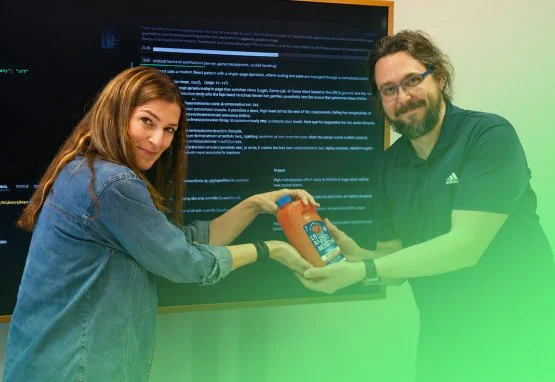
Tomas & RobotMirror were unanimously chosen as the winners for the creativity of their idea and execution, and with the prize, we returned to the analog world thanks to the power of the Home Plumber and the crossword puzzle!