

SERVICES
Managing AI-Native Product Development
AI accelerates development, but value is only created when people change the way they work.
As solutions are developed at an ever-faster pace, the role of holistic management and change leadership becomes increasingly important. We take a business need and turn it into a concrete framework that AI agents and developers can build upon. We then coach the organization to do the same on its own.
It all starts with leadership and data: before anything is built, we agree on the metrics we’ll use to assess whether it was worth it.
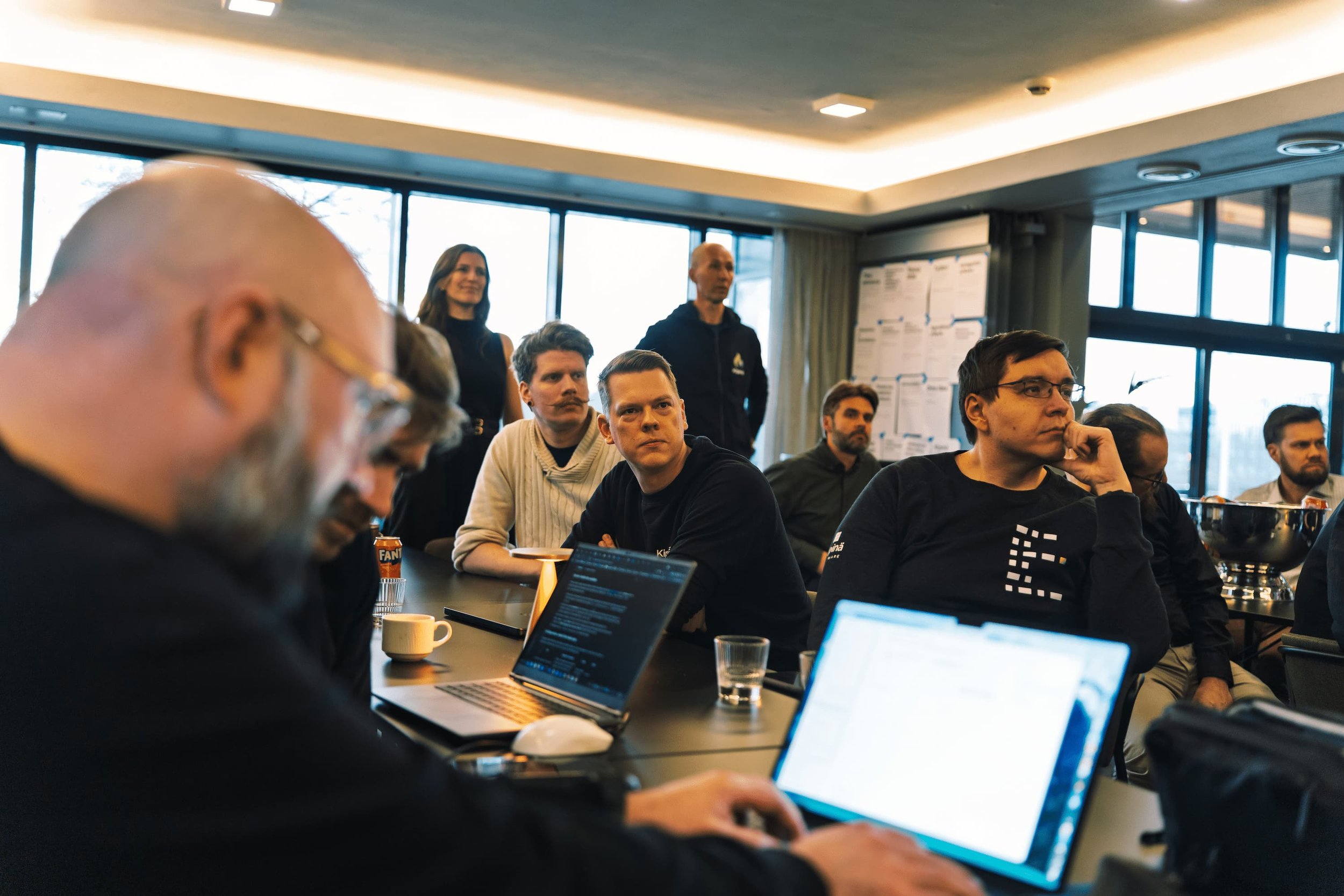
THE GLUE THAT HOLDS PROJECTS, TEAMS, AND TOOLS TOGETHER
AI Product Leadership transforms the speed enabled by technology into business speed and growth.
AI-native product development requires a fundamental shift in mindset. Through multidisciplinary expertise and strong leadership, both development teams and organizational leadership are guided away from a focus on cost efficiency toward genuine, growth-driven development.
With the rise of agent-based development, the key factors in the success of digital development projects have shifted from technical implementation toward business objectives. It is no longer just a matter of how to implement good ideas, but rather what is worth developing and why.
For which business objectives is it worth using AI?
What knowledge and technology does it require?
How can we align business, technology, and user needs?
How can we ensure that slow decision-making doesn't hinder progress?
How do we move from pilot projects to a sustainable operating model and measurable business value?
“With AI, the primary goal of solutions is often cost savings. The more important question, however, is how it can be used to gain a real competitive advantage and create more value.”
With agent-based software development, development teams can accomplish more in the same amount of time. In very few organizations, decision-making, prioritization, and organizational practices scale automatically along with this.
A gap emerges between technical work and the rest of the organization. The development team may be ready to move forward, but decisions, a shared direction, or business readiness are not yet in place.


“The development team may be ready to move forward in a matter of weeks, but decisions, priorities, and business readiness don’t automatically scale at the same pace. Leading AI-native product development is therefore about change management: people, decision-making, and technology must be brought into sync.”
Arto Kellokoski
AI Product Manager, Partner at Kipinä
Three Core Principles Underpinning the AI Product Manager's "
"
"Done" is always a momentary state. Organizations, markets, and AI are constantly changing, and what worked a moment ago may no longer work. Continuous leadership ensures that agreed-upon matters are not forgotten, that a shared understanding does not erode, and that new ways of working do not drift back into old habits.
1 - Shared understanding: Everyone knows what has been agreed upon and why.
2 - Work Rhythm: Shared Practical Matters Keep Things Moving
3 - The Solution Itself: The quality of AI outputs is regularly reviewed, agents and workflows have designated owners, and humans retain the final say in decision-making.
“We turn a business need into something that AI agents and developers can build. But first, let’s agree on how we’ll determine whether it was worth it.”
AI PRODUCT MANAGER BRINGS EXPERTISE TO TEAMS
For each project, we work with the client to develop an operating model, service design, and a blueprint for implementation, and we train the teams to carry out the work themselves.
The AI Product Leader acts as an enabler and liaison between management, the business, and the technical teams. The AI Product Manager is responsible for ensuring that business needs, people, and AI-native development are all aligned.
We help leadership identify where AI delivers the most value, prioritize actions, and make decisions at the speed required by the new pace of development. At the same time, we build a shared understanding of what AI-native product development means for the organization and how to turn its potential into a practical model for action.

From concept to production in 10 weeks: The speed of AI-native development comes from people and the way we work, not just from technology.
READ THE BLOG
FREQUENTLY ASKED QUESTIONS
AI Product Leadership & Agent-Based Software Development
-
AI Product Leadership—that is, leading AI-native product development—brings together business objectives, people, decision-making, and agent-based software development. The goal is to transform the technological speed enabled by artificial intelligence into business speed, a competitive advantage, and measurable growth.
-
An AI Product Manager is most valuable when an organization wants to leverage artificial intelligence in product development, but decision-making, prioritization, or a lack of common practices are slowing down progress. This is especially true when there are many AI experiments, but few make it into production or generate measurable business value.
-
AI agents accelerate software development, but an organization’s decision-making and operating practices do not speed up on their own. AI-native product development requires clear goals, a shared understanding, data-driven prioritization, and rapid learning. Above all, it is about change management—ensuring that people, business, and technology operate in sync.
-
The AI Product Manager translates business needs into actionable components that developers and AI agents can implement. They are responsible for building a shared understanding, service design, defining an operating model, and specifying concrete goals, as well as guiding the organization toward AI-native product development. Development is driven by hypotheses, data, and user feedback.
-
A traditional Product Owner typically focuses on maximizing product value and prioritizing development work. The role of an AI Product Leader extends more broadly to transforming the organization’s operating practices, leading change, and leveraging agent-based software development. They combine strategic goals, people’s expertise, and the potential of technology, and develop the organization’s ability to innovate independently.
-
Although artificial intelligence can reduce manual work and streamline software development, the primary goal of AI Product Leadership is to increase business value. Faster experimentation, better decision-making, and a shorter time from idea to production enable new business opportunities, competitive advantage, and growth.